San Diego Coastkeeper Ocean Gala Custom Art

November 15, 2008 – 9:08 pm

The Frame Maker is pleases to support San Diego Coastkeeper tonight with a donation to the silent auction portion of their annual Ocean Gala.

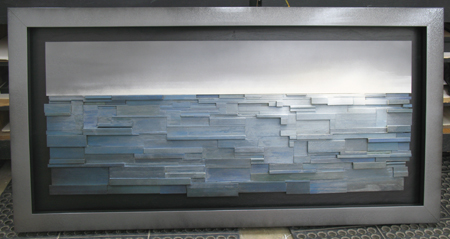
Created by artist and TFM general manager John Hiemstra, “Ocean Abstract #3” is the next in a series created from resins, plasters, waxes and paints left from John’s work as a faux finish and mural contractor.

Ocean Abstract#3 by John Hiemstra, scenic artist
This particular piece was inspired by and created out of materials recycled from the production picture framing operations at The Frame Maker, including maple, pine and bass woods, plexiglass and wood composites.The framing materials are also recycled, the mounting board from a shipping crate and the frame from an over order of moulding.The completed frame was then custom refinished to work with the piece, one of many new services John has implemented at The Frame Maker this year.

TFM in October San Diego Home & Garden

October 17, 2008 – 9:57 pm

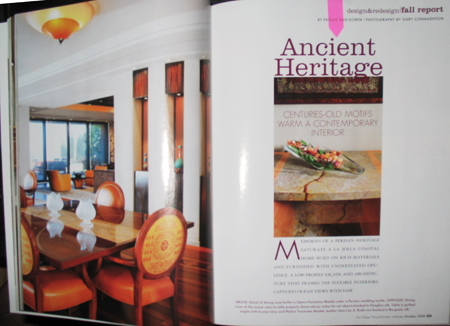
The Frame Maker is pleased to have contributed to a stunning residence featured in the month’s issue of San Diego Home & Garden Lifestyles.

interior design feature in San Diego Home & Garden magazine
cover page of “Ancient Heritage” feature

Designed by Island Architects & Arthur Porras Asociates (ASID), this coastal home in La Jolla is “built on rich materials and furnished with understated opulence”, according to SDHG.

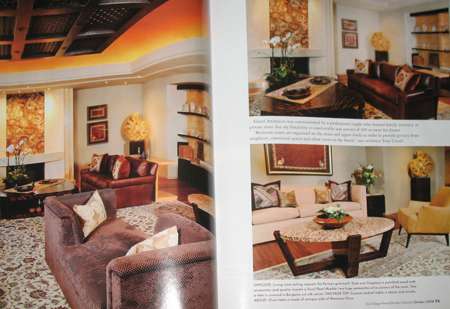
Our frames grace the living room and family room in the pictures below:

La Jolla interior design featured in San Diego Home & Garden magazine
different views of the living room

Green case study #5: how does it work?

September 30, 2008 – 5:42 pm

In the last post, I had worked my way back to the example of Sierra Pine’s sustainable MDF line as an area of growth driven by demand for a clean, “green” product.

Another reason Sierra Pacific is such a great example is that their marketing and copy on their website clearly demonstrate the how to of placing a green product in the marketplace.

Since anyone could claim “green” credentials for a process or product without having to prove anything specific about their process or product, the main watchword among serious green designers and builders is “certification”, in other words, verification or proof that the practice or product in question really is “green”. There is one primary reference system for green building that has emerged over the last decade.

The Leadership in Energy and Environmental Design (LEED) Green Building Rating System™ is a

third-party certification program and the nationally accepted benchmark for the design, construction and operation of high performance green buildings. LEED provides building owners and operators with the tools they need to have an immediate and measurable impact on their buildings’ performance.

The Leadership in Energy and Environmental Design (LEED) Green Building Rating System™ encourages and accelerates global adoption of sustainable green building and development practices through the creation and implementation of universally understood and accepted tools and performance criteria.

from the U.S. Green Building Council website

Now back to Sierra Pine’s fine example: one of the reasons their “green” marketing message is so clear is because they show you which specifics of the LEED code their product addresses, the number of LEED “points” toward overal LEED certification potentially available to a project by using Sierra Pine products, and most importantly, real instruction on what the benefits of “green” design really are to a project, the consumer and the environment.

For example, if you click on the Environmental tab of the Sierra Pine web site and then choose “LEED Credit Support”, you’ll find this concise description of how their products fill certain specific needs of green designers and builders working within LEED guidelines:

SierraPine products support 6 credits in the categories of Materials and Resources and Environmental Quality.

Materials & Resources 4.1 & 4.2 – Recycled Content
Materials & Resources 5.1 & 5.2 – Regional Materials
Materials & Resources 7 – Certified Wood
Environmental Quality 4.4 – Use of No Urea Formaldehyde

While their page goes on to detail which of their products meet standards in these different categories, right away we can get a feel for some aspect of what “green” means under the LEED guidelines:

1. The use of recycled materials, in this case, wood industry waste and by-products.

2. Buying locally: SierraPine is locates in New York State and their products support these LEED credits on any project within a five hundred mile radius of their production facilities.

3. Using certified lumber: There is one primary third party certification agency for wood products,  The Forest Stewardship Council , whose “standards represent the world’s strongest system for guiding forest management toward sustainable outcomes.” In choosing lumber certified by FSC over non-certified materials, a company like Sierra Pine is actually doing some of the enforcement work of getting clean materials into the marketplace– they are in fact casting one of the strongest votes known to man– the allocation of money–for “green” materials.

4. Urea Formaldehyde is a highly carcinogenic material widely used in the wood composite industry, especially in traditional MDF manufacturing. The toxic compounds are released both in manufacturing processes and slowly emitted over time from finished products as materials decay.

Keeping these kinds of toxic chemicals, carcinogens and their emissions out of our hotel rooms, bedrooms, and offices (three places where lots of MDF is typically used-sorry, Ikea) is another key aspect of the LEED guidelines, and using LEED certified products like Sierra Pine MDF instead of traditional alternatives and/or non-certified alternatives is how “green” designers and builders make real differences, both in the marketplace and in the indoor environments we inhabit.

Green case study #4: whats in it for me?

July 27, 2008 – 7:59 pm

Its the business owner’s bottom line, after any pitch or presentation about anything, especially for a relatively unproven niche market like “green” building or design: how does this product/service/alternative help me and my business make money?

If you own or manage a business and read any of these articles about “green” MDF, you’re probably asking this same question from a slightly different angle: sounds good, especially the health stuff, but how much extra is it going to cost?

While susceptible to the second approach, I prefer the first because it opens up a whole new perspective on the everyday issues facing business owners, managers and entrepreneurs that have become increasingly grim over the last couple of years: the radical decline in value of real estate, stock and other investments, the credit squeeze on business brought on by the credit “max out” of the general consumer, the rise of gas prices and fall of foot traffic, the ridiculous cost of healthcare, unfavorable price competition from China and other emerging global economies, degradation of our own water, air, climate and health as a result of business activity, etc.

After visiting the Hospitality Design Expo in May, I saw one of the ways in which the solutions necessary for positive change on the environmental front can cause positive developments in other areas of concern to business owners, including financial concerns.

In other words, to echo Bill Clinton, Al Gore, and several other forward-looking leaders in our society, there is economic opportunity in the growth of green for business owners, because there is authentic demand for what “green” design can deliver to practitioners, consumers and local economies alike.

So how does it work? And what does any of this have to do with picture framing?

It will take a few more posts to sort through all this even as just an overview, so I will start by concluding this post with what I think is an important piece of context for discussing green design.

A good chunk of small business/entrepreneurial growth in the US over the last ten years has been in businesses that have leveraged cheap labor abroad and cheap energy to ship overseas goods cheaply into our country. At the same time, many business have learned to leverage the internet in order to reach new customers at great distances and leveraged other services like Federal Express and UPS to fulfill those far away sales, opening up new markets and accelerating the spread of information and market presence well beyond traditional regional and word-of-mouth boundaries.

Unfortunately, the particulars of the unprecedented global economic growth characterizing the beginning of the 21st century include some nasty side effects, including counterfeiting, trademark and copyright infringement;  severe environmental pollution, widespread health problems;  small business failure and greater unemployment due to overseas competition and “outsourcing”; and occasions of dangerous “goods” being marketed here at home.

These negatives, coupled with the radical rise in energy and transportation costs, create the opening for  green design and green products to flourish in economic terms.

For instance, we are currently seeing a surge in gas prices that is crimping many segments of the US economy and directly impacting thousands and thousands of our fellow citizens who have built their homes, families and businesses around a driving lifestyle.

The car makers ahead of the curve on smaller high mileage vehicles are the new #1 and #2 selling carmakers in the United States for the first time in history and employ more workers and have made more investment in local communities through expansion and growth over the last ten years than their newly deposed American counterparts.

In theory, greater demand for these “green” vehicles should spur growth and investment, so that ultimately, through innovation and foresight, higher gas prices=more new jobs and opportunities— rather than less.

In our business at The Frame Maker, freight and handling charges on some of our most unique frames made custom outside of San Diego county have grown so high that we are now building a network of artisans here in San Diego in order to keep these one of a kind custom frame designs both affordable to our clients and profitable for us. So, high energy costs=more work opportunities for local artisans.

Similarly, many people have suffered through health problems (or their loved ones have) brought on by exposure to toxic substances. As people become more aware of what chemicals are actually used in their mattresses, carpets, and furniture, and the fact that those chemicals continually leech out into their surrounding environment,  so the demand grows for alternative products that reduce or eliminate the use of these substances. Sierra Pine’s “Formaldehyde free adhesive system” for making MDF is a great example of green design turning a health and environmental negative into an economic positive.

So while recycling is great (and we’ll talk about that soon in relation to the picture framing industry), its the spirit of innovation in green design that interests and excites us here at The Frame Maker– more in the next post.

Green case study part 3: clean, green MDF

June 29, 2008 – 4:58 pm

There are solutions for some of the “green” issues I’ve discussed about MDF- what’s it made from, what its made with, and so on– and I mean real solutions in the form of product available in the marketplace today.

Check out Sierra Pine an established wood-composite manufacturing company that supplies a number of products to the design/build industries, including MDF sheet goods, particle board and mouldings made from MDF as well.

Their sustainable product line features water resistant MDF for wet areas, fire-retardant MDF for modern building code requirements, mouldings, basic building sheets ALL from a sustainable source and process:

“SierraPine’s structure is centered on the use of 100% recycled or recovered fiber, and through strategic investment, is a major consumer of post-consumer recycled wood waste that is diverted from the waste stream. In addition to the use of post-consumer recycled fiber, one of SierraPine’s core values is that all fiber we use originates from sustainably managed forests and agricultural operations.

SierraPine has been an industry leader for two decades in the production of composite panel products that utilize formaldehyde-free adhesives. Our commitment to furthering the development of this and other ultra low emitting resin technologies in all our operations has been demonstrated by the new products we continue to introduce into the marketplace that have been engineered for specific applications.” (from sierrapine.com “Environmental Policy Statement”)


They take their statement a step further by addressing some of my points about energy usage and the mechanics of the manufacturing process:


“SierraPine is also committed to ensure environmental compliance in the communities in which we operate. This includes constant investment in equipment and process control that reduces energy and water usage. We achieve this commitment by setting high expectations for environmental performance, training employees on regulatory and operating permit requirements, ensuring regular inspection of manufacturing facilities and holding all employees accountable for their actions and safe work practices. We will continually integrate environmental stewardship into our daily work activities.”


Sierra Pine’s presentation of their sustainable materials includes one final component that makes them an excellent example of and introduction to the world of green building materials, and I will talk about that in detail in the next post here.